
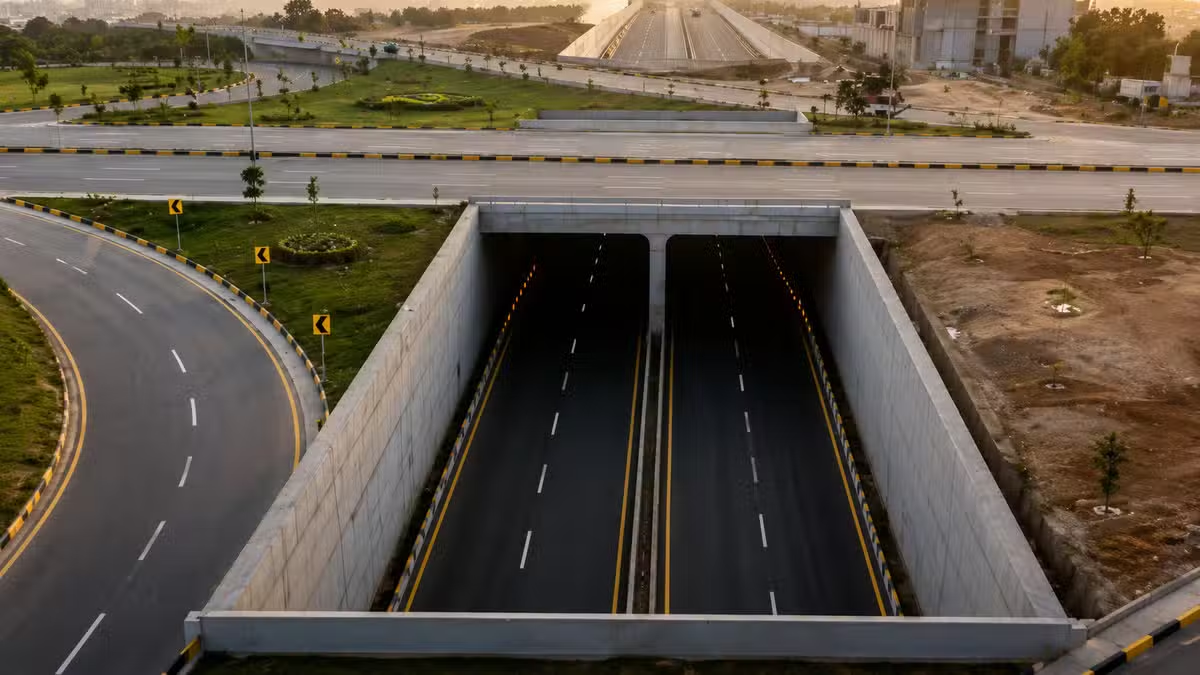
A recent audit report by the Auditor General of Pakistan has reportedly identified a major design flaw in Islamabad’s 9th Avenue and Jinnah Avenue interchange, raising concerns about road safety and engineering standards. The underpass, named after the Turkish President, has come under scrutiny after auditors warned that its current design could pose a significant risk to motorists.
According to Audit Report DGAWF-26-002, covering the audit year 2025-26 and the financial years 2023-24 and 2024-25, the interchange contains structural features that may compromise driver safety. The findings have prompted fresh questions about the planning, design approval, and implementation of one of the capital’s key infrastructure projects.
The audit reportedly points to the underpass loop, which includes a sharp turn of approximately 45 degrees. Adding to the concern, a solid concrete wall is positioned directly ahead of the curve, creating what auditors described as a “significant safety hazard” for motorists using the route.
One of the key observations in the report relates to the project’s design speed. According to the audit findings, the underpass loop was engineered for vehicles traveling at around 30 kilometers per hour. However, the original feasibility study for the project had specified a design speed of 60 kilometers per hour.
This difference between the approved design specifications and the completed structure has raised concerns about whether the project fully adhered to the original engineering standards. Transportation experts generally emphasize that road geometry should align with approved design speeds to ensure smooth traffic flow and reduce the likelihood of accidents.
Infrastructure audits are conducted to assess whether public projects comply with technical specifications, safety requirements, and financial regulations. Such reviews help identify deficiencies that may require corrective measures while improving accountability in the execution of government-funded developments.
The reported findings are expected to draw attention from engineers, urban planners, and policymakers responsible for Islamabad’s road infrastructure. If safety concerns are confirmed through further technical evaluation, authorities may consider modifications to improve the interchange’s design and reduce potential risks for commuters.
The 9th Avenue and Jinnah Avenue interchange serves as an important traffic corridor in the federal capital, carrying thousands of vehicles each day. Ensuring that the interchange meets modern engineering and safety standards remains essential for protecting motorists and maintaining efficient traffic movement.
The audit report is also likely to renew discussions on the importance of independent oversight in large-scale public infrastructure projects. Regular technical inspections and transparent reviews can help identify shortcomings early, ensuring that taxpayer-funded developments deliver both quality and public safety.
Authorities have yet to announce whether any redesign or remedial work will be undertaken in response to the audit observations. As the findings receive greater public attention, stakeholders will be watching for official responses and any corrective measures aimed at addressing the reported safety concerns.
Author

webdesk@pakbuzztoday.com
Related Posts

Islamabad Court Issues Bailable Arrest Warrants for CDA Chairman
An Islamabad civil court has issued bailable arrest warrants for the chairman of the Capital Development Authority (CDA) over the alleged failure...

Motorway Police Opens Driving License Facilitation Center in Sindh
The National Highways and Motorway Police (NHMP) has opened its first Driving Licensing Authority (DLA) Facilitation Center in Sindh, introducing technology-based driving...

Pakistan Consulate Jeddah Launches Online Appointment System for NADRA and Passport Services
The Consulate General of Pakistan in Jeddah has introduced a new online appointment system for NADRA and Machine-Readable Passport (MRP) services, providing...

PIA Board Approves Leasing of Five Boeing Aircraft for Europe and UK Operations
The board of Pakistan International Airlines (PIA) has approved plans to lease five Boeing aircraft as the national airline prepares to support...

Makkah Grand Mosque Muezzin Sheikh Ibrahim Al-Madani Passes Away at 51
Sheikh Ibrahim bin Adel Al-Madani, a muezzin at the Grand Mosque in Makkah, has passed away at the age of 51, according...

Fast Cables Seeks Approval for Rs. 1 Billion Capital Plan
Fast Cables Limited has proposed a capital plan worth more than Rs. 1 billion, with the company seeking shareholder approval to use...