
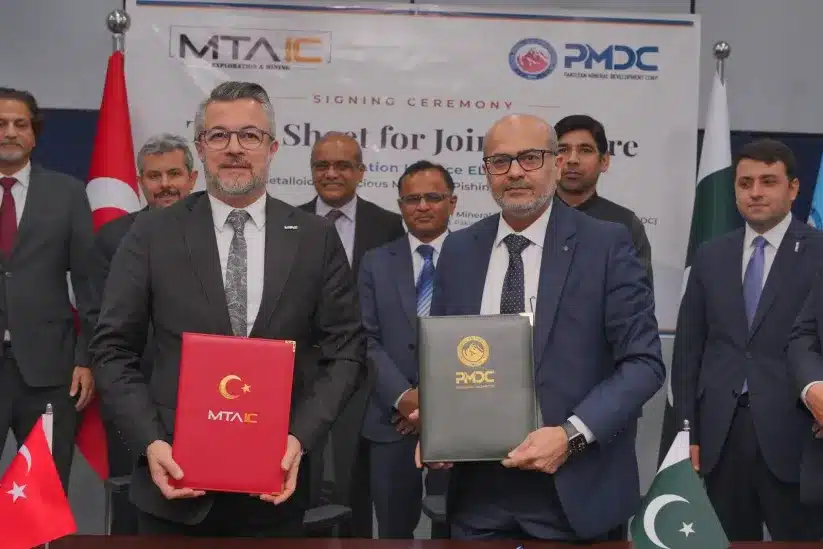
Pakistan and Türkiye have taken a step towards strengthening cooperation in the mining sector after the Pakistan Mineral Development Corporation (PMDC) and Türkiye’s MTA International Company (MTAIC) signed a term sheet to jointly explore and develop mineral resources in Balochistan.
The agreement was signed in Islamabad on October 16, 2026, and covers several valuable minerals, including antimony, copper, gold, silver, and molybdenum. The project will focus on mineral exploration and the potential development of mining operations in Pishin district.
Under the agreement, the two organizations will work together on Exploration License EL-318, which covers an area of 498.82 square kilometers. The proposed collaboration includes exploration, mining, mineral processing, and marketing.
The partnership reflects growing interest in developing Pakistan’s mineral resources through international cooperation and technical collaboration. Balochistan, in particular, has attracted attention because of its mineral potential and opportunities for further exploration.
Antimony, copper, gold, silver, and molybdenum are used in a range of industrial and commercial applications. Copper plays an important role in electrical equipment and infrastructure, while gold and silver are used in jewellery, investment products, and various industrial processes.
Antimony is used in products such as flame-retardant materials and certain alloys. Molybdenum is valued for its role in strengthening steel and improving the performance of industrial materials.
Exploring these resources could help improve understanding of the mineral deposits available in the licensed area. However, the commercial potential of the project will depend on exploration results, the quality and quantity of identified deposits, and the feasibility of developing mining operations.
The involvement of MTA International Company also creates an opportunity for cooperation between Pakistani and Turkish organizations in mineral development. Depending on the project’s implementation, collaboration could involve technical expertise, exploration methods, processing capabilities, and mineral marketing.
The agreement covers several stages of the mining value chain, extending beyond the initial search for mineral deposits. Exploration is generally required to assess the location, size, and quality of deposits before decisions can be made about commercial extraction.
Mining and processing activities would then depend on the findings of exploration work, the project’s economic viability, and the necessary regulatory approvals. Marketing would form another part of the proposed arrangement, connecting any commercially recoverable resources with potential buyers.
For Pakistan, developing mineral resources could offer opportunities to attract investment, expand industrial activity, and generate employment. Mineral projects may also support related businesses, including transport, engineering, equipment supply, and processing services.
At the same time, successful development requires careful planning, environmental safeguards, transparent licensing procedures, and effective oversight. These factors are important for ensuring that mining activities are conducted responsibly and that potential economic benefits are balanced with local and environmental considerations.
The signing of the term sheet marks a step towards joint mineral exploration in Pishin, but it does not by itself confirm the discovery of commercially viable reserves or the start of full-scale mining. Further exploration and project development will be important in determining the agreement’s eventual results.
The Pakistan-Türkiye partnership highlights the potential for bilateral cooperation in the minerals sector. Its long-term significance will depend on exploration findings, investment decisions, and how effectively the proposed activities progress from initial assessment to possible commercial production.