
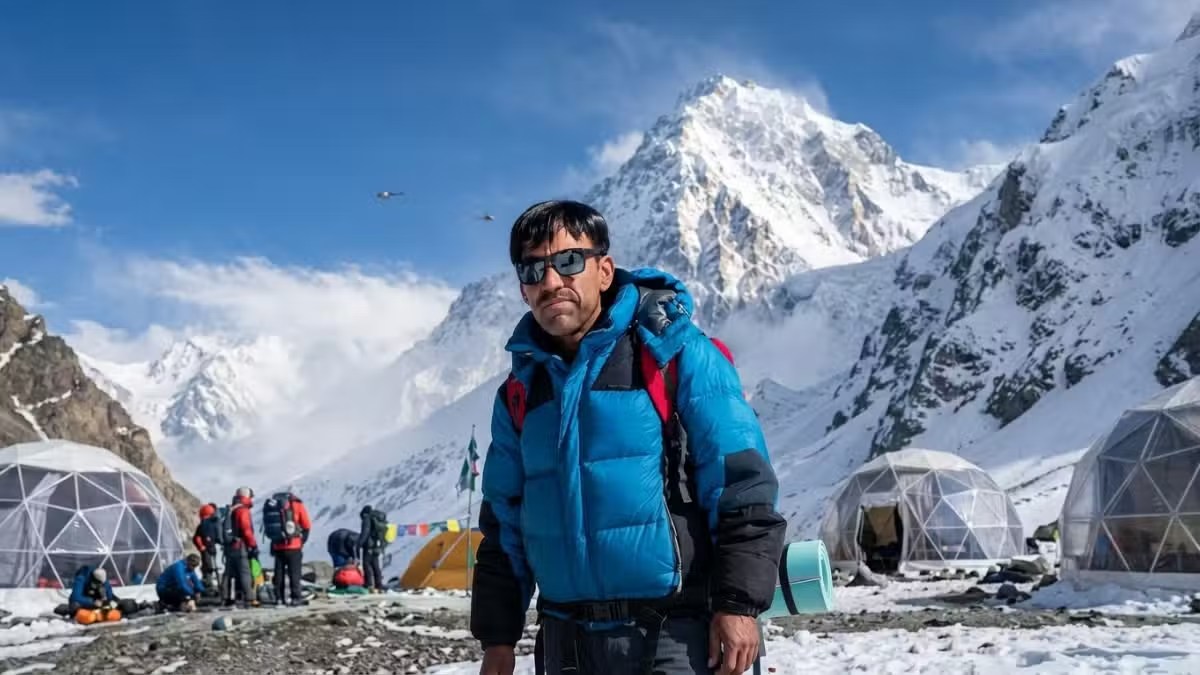
The body of Pakistani mountaineer Syed Ali Shah has been recovered from Falak Sar Peak in Kalam Valley, 54 days after he died in an accident during his descent from the mountain.
Following the recovery, his body was transported to his native village of Asala in Khwazakhela, Swat, where he was laid to rest.
Syed Ali Shah, a resident of Asala in Khwazakhela tehsil, had started his mountaineering journey from Kalam on July 5. He was accompanied by a six-member team that planned to summit Falak Sar Top.
The team successfully reached the approximately 5,985-meter-high peak before beginning its descent. However, the return journey turned tragic when Shah suffered an accident while coming down from the mountain.
The difficult terrain and challenging conditions at the peak made recovery operations particularly difficult. His body remained at the mountain for more than seven weeks before it could finally be recovered.
The recovery of the mountaineer’s body after 54 days brings an end to a prolonged wait for his family and community in Swat. His remains were subsequently taken to his hometown, where relatives and local residents gathered for his burial.
Falak Sar is among the prominent high-altitude peaks in the Swat region and attracts mountaineers because of its challenging terrain and considerable elevation.
Mountaineering in northern Pakistan can involve significant risks, particularly during summit descents. Steep slopes, difficult weather, rocky terrain and limited access can make rescue and recovery operations extremely challenging.
For mountaineers, the descent can be as demanding as reaching the summit. Fatigue after a successful climb can also increase the difficulty of navigating hazardous mountain routes.
Syed Ali Shah’s death highlights the risks faced by climbers exploring Pakistan’s high-altitude mountain regions. The country is home to some of the world’s most challenging peaks, attracting both local and international mountaineering teams.
The long recovery operation also demonstrates the difficulties authorities and rescue teams can face when dealing with incidents in remote mountainous locations.
For Shah’s family, the recovery of his body after 54 days provided an opportunity to bring him home and perform his final rites in his native village.
The incident has also drawn attention to the importance of safety, preparation and emergency support for mountaineering expeditions in Pakistan’s northern areas.
As adventure tourism and mountaineering continue to attract visitors to the country’s mountainous regions, improved rescue coordination and safety measures remain important for protecting climbers and local expedition teams.
Author

webdesk@pakbuzztoday.com
Related Posts
Sindh Records Pakistan’s Lowest Rainfall During 2026 Monsoon Season
Sindh experienced the lowest rainfall among Pakistan’s provinces during the 2026 monsoon season, with the province receiving significantly less rain than its...

Tax Lawyers Urge PM Shehbaz to Restrict FBR Enforcement Powers
The Multan Tax Bar Association (MTBA) has urged Prime Minister Shehbaz Sharif to review the enforcement powers of the Federal Board of...
IMF Raises Concerns Over Pakistan’s Low Agriculture Tax Collection
The International Monetary Fund (IMF) has raised concerns over Pakistan’s weak collection of agricultural income tax despite significant increases in tax rates...

Noor Zaman Secures Third Place at Asian Games 2026 Squash
Pakistan’s Noor Zaman secured third place in the men’s singles squash competition at the Asian Games 2026 after defeating compatriot Muhammad Ashab...

Islamabad Court Issues Bailable Arrest Warrants for CDA Chairman
An Islamabad civil court has issued bailable arrest warrants for the chairman of the Capital Development Authority (CDA) over the alleged failure...

Motorway Police Opens Driving License Facilitation Center in Sindh
The National Highways and Motorway Police (NHMP) has opened its first Driving Licensing Authority (DLA) Facilitation Center in Sindh, introducing technology-based driving...