
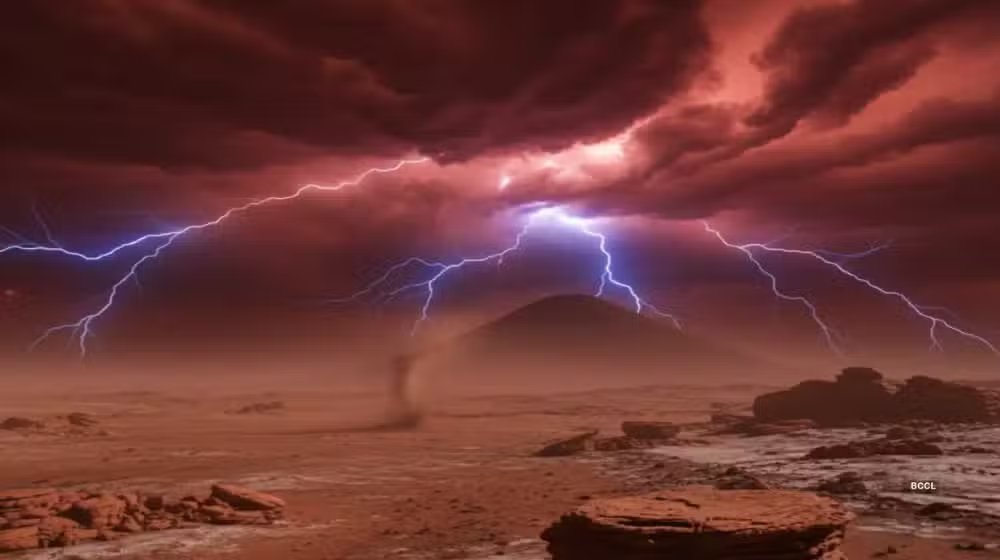
In a groundbreaking scientific development, NASA has confirmed the first-ever evidence of lightning on Mars. The discovery comes from faint electrical “zaps” captured by the Perseverance rover’s onboard microphone during a recent dust storm, marking a historic moment in planetary research.
For decades, scientists theorized that Mars’ massive and persistent dust storms might generate electrical discharges. However, direct confirmation remained elusive due to the planet’s thin atmosphere, unpredictable weather patterns and limited audio-based data collection. That changed when Perseverance, which has been exploring the surface of Mars since 2021, unintentionally recorded tiny electrical disturbances—evidence of lightning-like activity.
The findings, published in the journal Nature, come from an analysis of background audio the rover captured while monitoring environmental conditions. Researchers detected subtle crackling sounds—far weaker than thunder on Earth but strong enough to indicate electrical activity within Mars’ swirling dust clouds. The discovery provides the first concrete observational proof that Martian dust storms can indeed produce lightning.
Scientists believe that the friction between dust particles during storms builds up static charge, eventually releasing it in rapid, tiny bursts of electricity. While these discharges are significantly weaker than Earth-based lightning, they provide valuable insights into Martian weather dynamics and atmospheric behavior.
The implications of the discovery are significant. Understanding the electrical environment on Mars is crucial for future human missions, as electrical discharges could affect equipment, communication systems and even habitats. The findings also help scientists refine climate models and improve predictions about dust storm behavior—a major environmental hazard on the Red Planet.
Perseverance’s unexpected detection also highlights the growing value of audio as a scientific tool. NASA engineers originally included a microphone on the rover to enhance public engagement and capture environmental ambiance, but the instrument has now proven invaluable for scientific discovery.
This breakthrough adds to Perseverance’s long list of achievements, from gathering rock samples to documenting ancient riverbeds and searching for signs of past microbial life. With Mars continuing to surprise researchers, the new evidence of lightning brings scientists one step closer to understanding the planet’s complex climate system.
NASA and planetary scientists worldwide are expected to deepen their studies following this discovery, as the Red Planet reveals yet another mystery waiting to be explored.
Author

webdesk@pakbuzztoday.com
Related Posts

Pakistan’s Weekly Inflation Hits 1.4-Year High Amid Rising Price Pressures
Pakistan is witnessing a renewed surge in inflation, as the Pakistan Bureau of Statistics reported a sharp increase in the Sensitive Price...

How to Watch Pakistan vs Turks & Caicos Islands FIFA Series 2026
The FIFA Series 2026 kicks off in Côte d’Ivoire with an exciting moment for Pakistan as its women’s national football team prepares...

Pakistan Launches One-Day Hajj Service to Simplify Pilgrim Process
In a significant सुविधा for intending pilgrims, the Ministry of Religious Affairs and Interfaith Harmony has introduced a streamlined one-day Hajj service...

JazzWorld Promotes Digital Healthcare and Insurance Access Through Apna Clinic and FikrFree
On World Health Day, Jazz highlighted its continued efforts to improve healthcare accessibility and financial protection through its digital ecosystem, JazzWorld. The...

Pakistan’s Rising Squash Star Mahnoor Ali Clinches International Junior Title in Malaysia
Pakistan’s youth sports scene continues to shine on the global stage as emerging squash talent Mahnoor Ali secured a major international victory....

Pakistan Announces Wrestling Squad for Asian Beach Games 2026
Pakistan has officially unveiled its wrestling lineup for the upcoming Asian Beach Games 2026, set to take place from April 22 to...